
Dry-Type Winding Transformers Using 1050 / 1060 / 1070 Pure Aluminum Strips
As a manufacturer of aluminum strip for electrical applications, we produce 1050, 1060, and 1070 pure aluminum strips for dry-type winding transformers with strict control over conductivity, dimensional tolerance, surface quality, and coil consistency. In transformer winding production, the stability of the conductor material directly affects winding efficiency, insulation reliability, temperature rise, and long-term operating safety. For this reason, high-purity aluminum strip remains an important conductor option for dry-type transformer coils in many industrial and power distribution projects.
Dry-type winding transformers require conductor materials with good electrical conductivity, stable mechanical behavior during winding, and a clean surface suitable for insulation wrapping or direct process integration. Among commercially pure aluminum grades, 1050 aluminum strip, 1060 aluminum strip, and 1070 aluminum strip are widely used because they combine high aluminum content with excellent formability and reliable electrical performance.
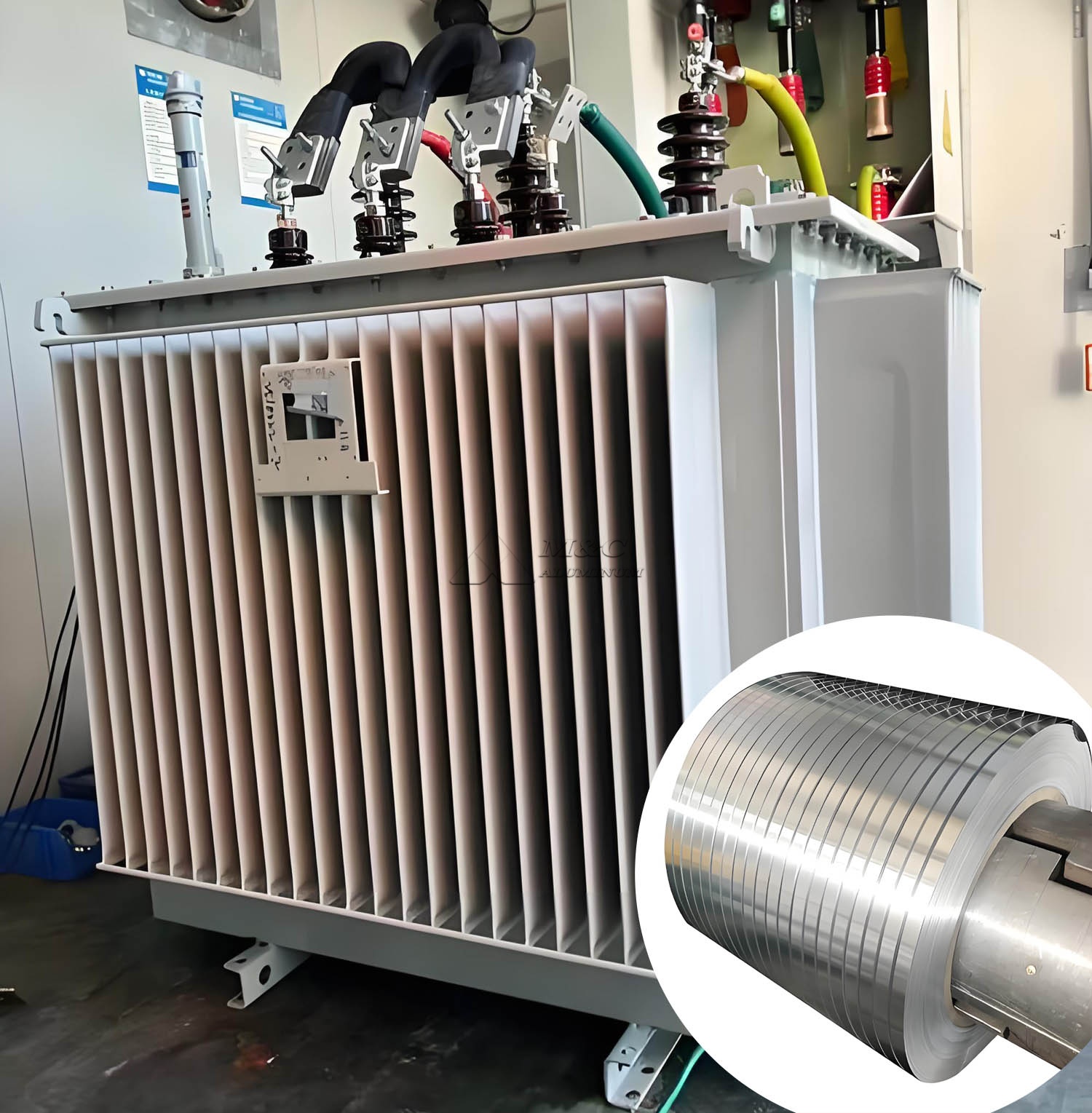
Why Pure Aluminum Strip Is Used in Dry-Type Winding Transformers
In dry-type transformers, the winding conductor must perform under repeated thermal cycles, electromagnetic stress, and insulation system constraints. Compared with general industrial strip, pure aluminum strip for transformer winding requires tighter production control. The key reasons for using 1050, 1060, and 1070 grades include the following:
High electrical conductivity for efficient current transmission.
Low density, which helps reduce total winding weight.
Good ductility for edge-stable winding and bending.
Uniform surface condition for insulation compatibility.
Cost efficiency in medium and large-capacity transformer production.
From a manufacturing perspective, the value of pure aluminum strip is not only in its nominal composition, but also in the consistency of the final coil. Conductivity variation, burr level, edge camber, thickness deviation, and residual stress all influence transformer winding performance. This is why transformer producers typically require specialized Transformer Aluminium Strip rather than general-purpose rolled strip.
Characteristics of 1050, 1060, and 1070 Aluminum Strips
The three grades belong to the pure aluminum series, but they differ slightly in purity level and conductivity. In practical transformer manufacturing, selection depends on current density, design margin, forming process, and procurement standards.
1050 Aluminum Strip
1050 aluminum strip contains at least 99.5 percent aluminum. It offers good conductivity, very good formability, and stable processing behavior. It is commonly used in transformer windings where the design balances electrical performance with economical material selection.
1060 Aluminum Strip
1060 aluminum strip contains at least 99.6 percent aluminum. It is one of the most commonly specified grades for dry-type winding transformers because it provides an excellent combination of conductivity, softness, and manufacturing consistency. For many transformer factories, 1060 is a standard grade for foil and strip winding conductors.
1070 Aluminum Strip
1070 aluminum strip contains at least 99.7 percent aluminum. Due to its higher purity, it provides better electrical conductivity than 1050 and 1060, making it suitable for applications with stricter conductivity requirements or optimized thermal performance targets.
Typical Technical Parameters
The exact specification of transformer aluminum strip depends on transformer capacity, winding design, insulation structure, and production equipment. As a factory, we customize the strip dimensions and temper according to coil winding requirements.
| Item | 1050 Aluminum Strip | 1060 Aluminum Strip | 1070 Aluminum Strip |
|---|---|---|---|
| Aluminum content | >= 99.5% | >= 99.6% | >= 99.7% |
| Typical temper | O | O | O |
| Thickness range | 0.2-3.0 mm | 0.2-3.0 mm | 0.2-3.0 mm |
| Width range | 20-1650 mm | 20-1650 mm | 20-1650 mm |
| Conductivity | about 61-62% IACS | about 62% IACS | about 63% IACS |
| Tensile strength | 60-95 MPa | 60-95 MPa | 55-90 MPa |
| Elongation | >= 20% | >= 25% | >= 25% |
| Edge condition | slit edge, burr controlled | slit edge, burr controlled | slit edge, burr controlled |
| Surface quality | clean, oil controlled, scratch controlled | clean, oil controlled, scratch controlled | clean, oil controlled, scratch controlled |
| Coil inner diameter | customizable | customizable | customizable |
| Application | dry-type transformer winding | dry-type transformer winding | dry-type transformer winding |
| MOQ | 1-3 tons | ||
The values above are representative production ranges for reference. Final parameters are adjusted according to customer drawings, winding equipment, and electrical design requirements.
Manufacturing Requirements for Transformer Winding Aluminum Strip
For dry-type winding transformers, the conductor must not only meet chemical composition standards, but also maintain process stability throughout slitting, winding, insulation wrapping, and assembly. We control the following production points during manufacturing:
1. Thickness Accuracy
Stable thickness is essential for consistent winding height, conductor cross-section, and electrical performance. Excessive thickness variation can cause uneven coil buildup and affect insulation spacing.
2. Edge Quality
Transformer winding strip must have smooth, burr-controlled edges. Poor edges may damage insulation paper, film, or coating during high-speed winding.
3. Surface Cleanliness
The strip surface must be clean and uniform, without significant rolling marks, oxidation defects, contamination, or transverse scratches. A stable surface condition supports downstream insulation and impregnation processes.
4. Soft Temper Stability
Most dry-type winding transformers use O temper material to ensure sufficient flexibility during coiling. Excessive hardness may lead to edge cracking or springback during winding.
5. Coil Uniformity
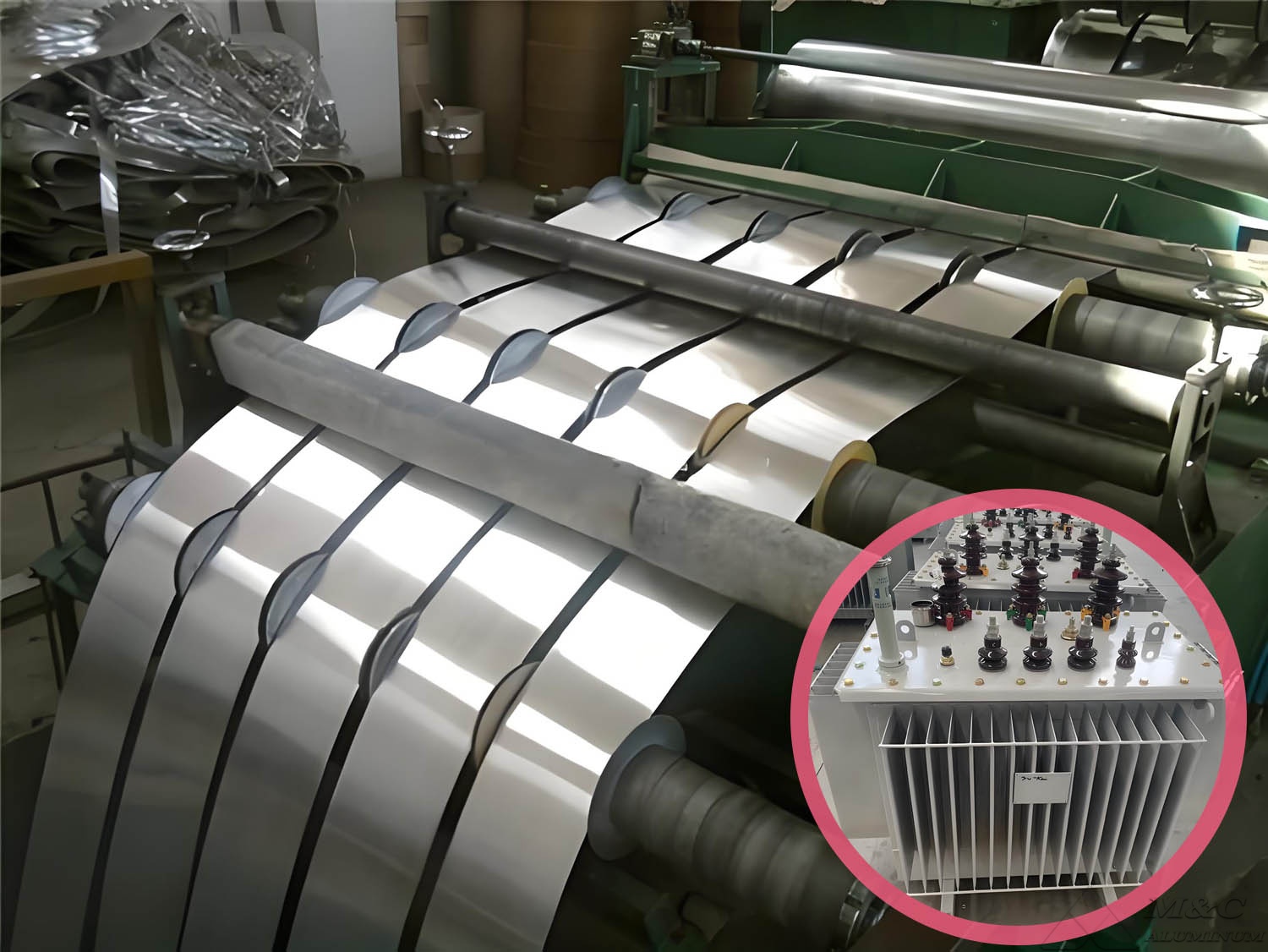
Good coil tightness and even winding help transformer manufacturers improve automatic feeding efficiency and reduce stoppage during coil processing. Our Aluminum Strip production line is configured to maintain uniform recoiling and stable strip flatness for electrical applications.
Performance Considerations in Dry-Type Transformer Applications
When selecting 1050, 1060, or 1070 pure aluminum strips, transformer manufacturers usually evaluate the following technical factors.
Electrical Conductivity
Higher conductivity reduces conductor loss and contributes to improved efficiency. In this respect, 1070 aluminum strip offers an advantage, while 1060 aluminum strip remains a widely accepted industrial standard due to its balanced performance and availability.
Winding Processability
Dry-type winding transformers often require long continuous strip lengths and stable deformation behavior during multilayer winding. Soft pure aluminum strip performs well in this process, especially when strip flatness and edge quality are well controlled.
Thermal Performance
Transformer windings generate heat under load. The conductor material influences resistance loss and temperature rise. While the cooling design depends on the full transformer structure, selecting a high-conductivity aluminum strip supports thermal management at the winding level.
Weight and Cost Efficiency
Compared with copper conductors, aluminum offers a lower density and a favorable cost structure. In many dry-type transformer designs, the use of pure aluminum strip helps optimize material consumption and total transformer weight while maintaining required performance targets.
Our Manufacturing Process for Pure Aluminum Transformer Strip
As a producer, we manufacture transformer aluminum strip from raw material selection to final slitting and inspection. The process typically includes:
Primary melting and alloy composition control.
Casting and homogenization.
Hot rolling and cold rolling to target gauge.
Intermediate annealing for structure stability.
Precision slitting to required width.
Final annealing to O temper.
Surface inspection, conductivity testing, and dimensional verification.
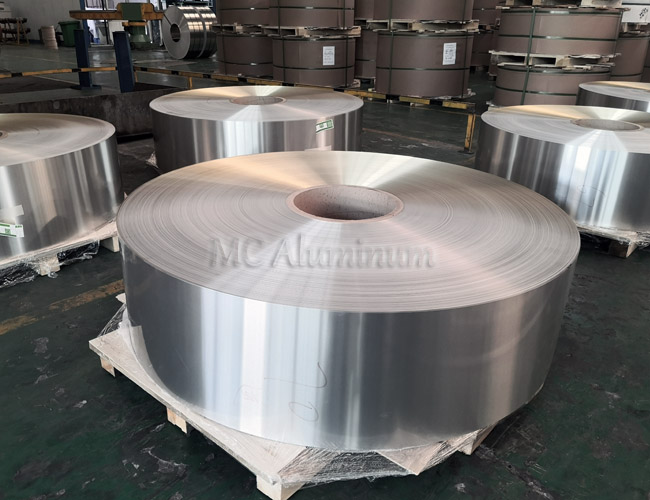
Coil packaging for export and plant handling.
This process control is especially important for 1050, 1060, and 1070 pure aluminum strips because transformer applications are sensitive to internal stress, surface condition, and conductivity consistency across the full coil length.
Common Application Scenarios
The 1050 1060 1070 pure aluminum strips we manufacture are used in a range of dry-type transformer products, including:
Cast resin dry-type transformers.
Vacuum pressure impregnated dry-type transformers.
Distribution transformers for industrial facilities.
Power transformers for commercial buildings.
Renewable energy transformer systems.
Electrical control and isolation transformers.
Depending on the transformer design, the strip may be used as layer winding conductor or as part of foil winding structures. Width, thickness, coil weight, and edge requirements are therefore determined jointly by the transformer designer and our production team.
How We Support Custom Specifications
In export supply for transformer manufacturers, standard catalog dimensions are often not sufficient. Many projects require customized thickness-width combinations, tighter conductivity targets, or specific packaging methods for automated production lines. We support customization in the following areas:
| Customization item | Available options |
|---|---|
| Alloy grade | 1050, 1060, 1070 |
| Temper | O |
| Thickness tolerance | according to technical agreement |
| Width tolerance | according to slitting requirement |
| Edge type | slit edge |
| Coil weight | customized for winding equipment |
| Inner diameter | customized |
| Surface standard | electrical application grade |
| Packaging | export wooden pallet, moisture protection, eye to wall or eye to sky |
| Test documents | chemical composition, mechanical properties, conductivity, dimensional inspection |
Conclusion
For dry-type winding transformers, 1050 aluminum strip, 1060 aluminum strip, and 1070 aluminum strip remain practical and technically reliable conductor materials when produced under strict electrical-grade manufacturing control. The final performance of the transformer winding depends not only on nominal alloy grade, but also on thickness precision, conductivity stability, edge quality, temper uniformity, and coil consistency.
As a factory specializing in pure aluminum strip for transformer winding, we focus on process-controlled production to meet the practical requirements of transformer manufacturers in international markets. By matching alloy purity, dimensional accuracy, and winding suitability to the actual transformer design, 1050, 1060, and 1070 pure aluminum strips can provide stable performance in dry-type transformer applications.
Contact Us