
Manufacturer of Aluminum Strip for Power Cable Armoring
As an aluminum rolling and slitting factory, we manufacture aluminum strip for power cable armoring for cable producers that require stable mechanical performance, clean surfaces, accurate dimensions, and consistent coil quality. Our production is focused on aluminum strip, aluminum coil, aluminum sheet, and related rolled aluminum products for industrial use. For cable armoring applications, we supply aluminum cable armor strip in selected alloys and tempers according to customer drawings, cable structure requirements, and applicable international standards.
Power cable armoring is designed to provide mechanical protection, improve impact resistance, and support cable integrity during laying, pulling, burial, and operation. Compared with steel armor, aluminum strip offers lower density, good corrosion resistance, non-magnetic performance, and easier handling. These properties make aluminum strip suitable for many low voltage, medium voltage, and special power cable designs, especially where weight reduction and corrosion control are important.
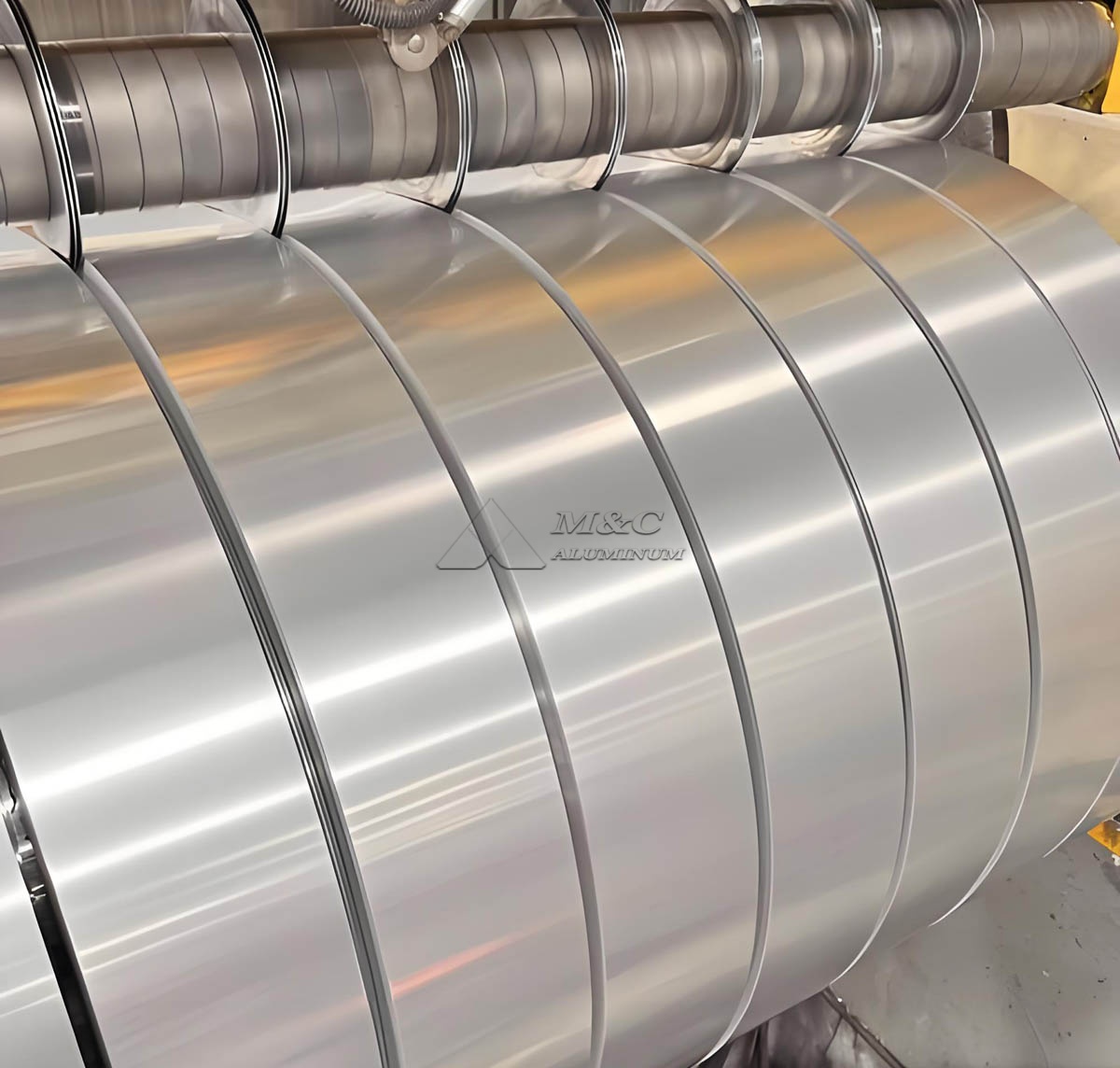
Factory Supply for Cable Manufacturers
We supply directly from our rolling and finishing lines. This allows us to control alloy selection, cold rolling reduction, annealing, tension leveling, slitting accuracy, edge condition, and packaging. For cable factories, stable strip quality is essential because the armoring process is continuous and high speed. Thickness variation, burrs, poor winding, or surface contamination may affect cable production efficiency and final product reliability.
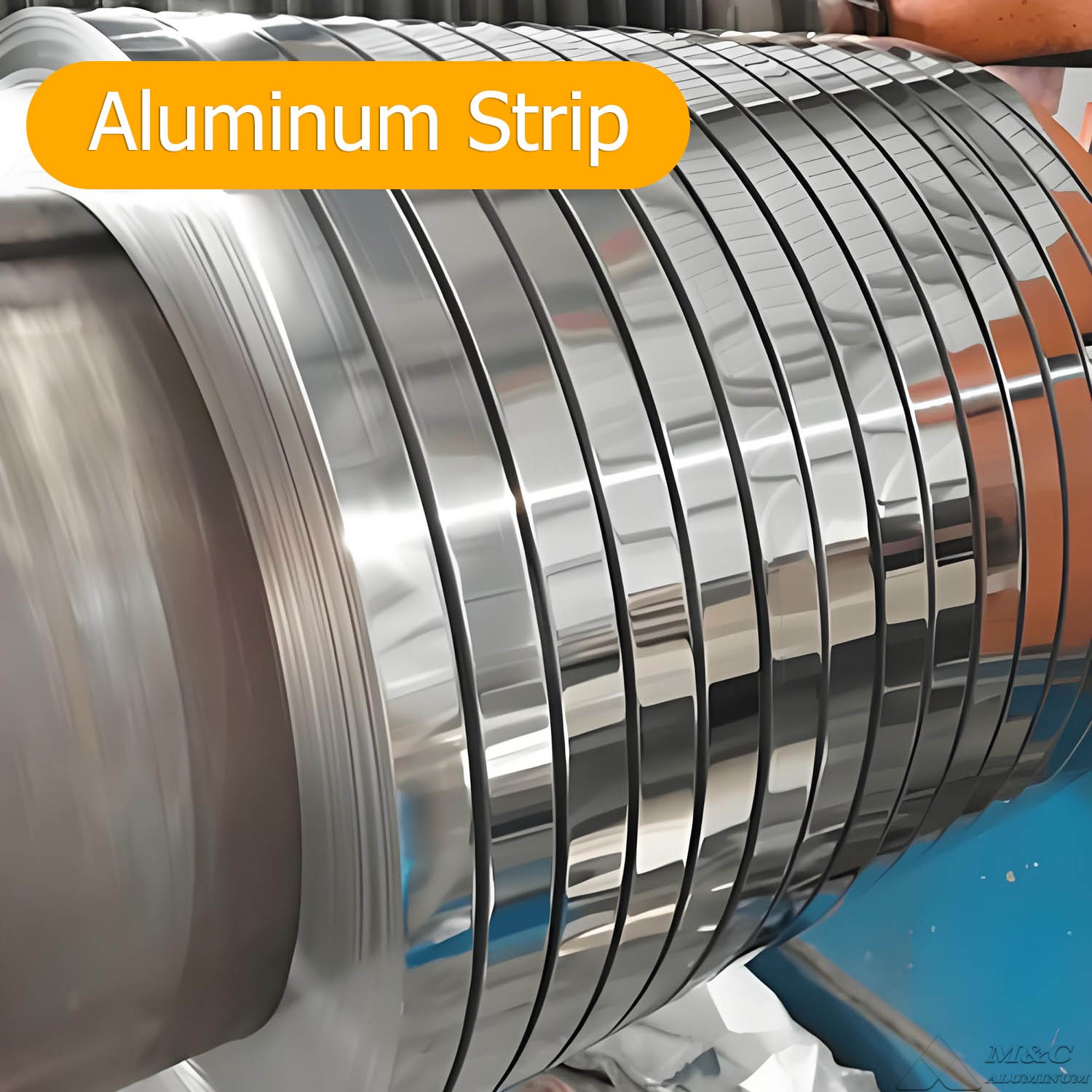
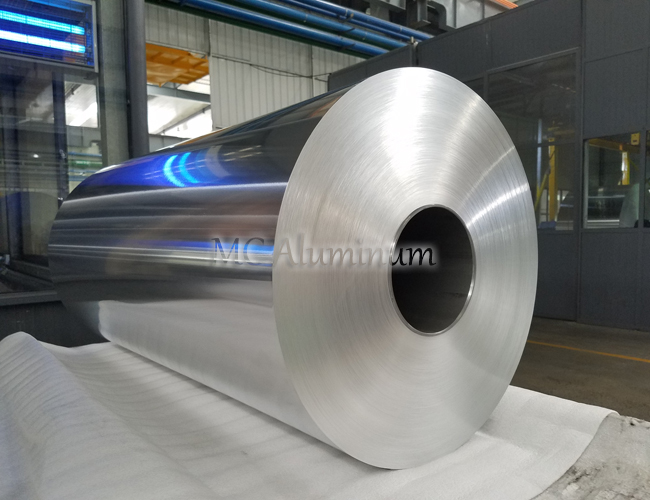
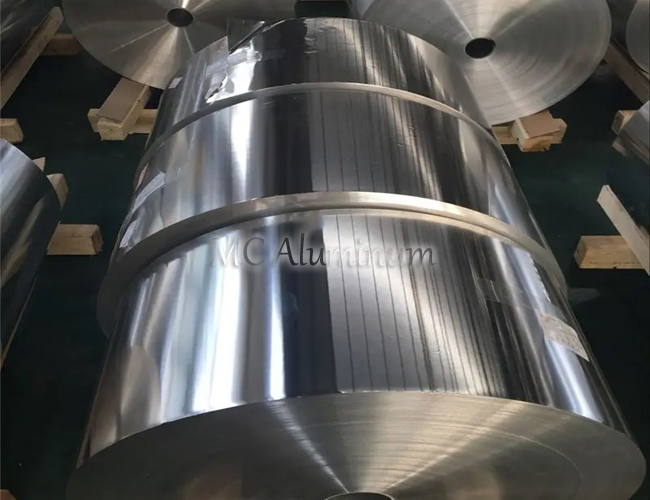
Our aluminum strip for power cable armoring is produced in coil form and can be slit to narrow widths according to the cable armoring machine. We can supply soft, semi-hard, or hard tempers depending on whether the strip will be helically wrapped, longitudinally applied, corrugated, or formed during cable production. Common options include 1050, 1060, 1100, and 3003 aluminum strip. For customers requiring general rolled strip specifications, our Aluminum Strip range can also be adjusted for related electrical and mechanical applications.
Why Aluminum Strip Is Used for Power Cable Armoring
Aluminum strip is selected for cable armor because it combines mechanical protection with practical manufacturing advantages. Its lower density reduces the overall cable weight, which is useful for long cable runs, transportation, installation, and offshore or infrastructure projects. Aluminum is also non-magnetic, which helps reduce magnetic losses in certain AC power cable applications.
The natural oxide layer on aluminum provides corrosion resistance in many service environments. When used with appropriate cable sheath design, aluminum armor contributes to durability in underground, industrial, and outdoor installations. Aluminum strip also has good formability, allowing it to be wrapped or shaped without cracking when the correct alloy and temper are selected.
For cable manufacturers, process consistency is equally important. A well-produced aluminum cable armor strip should unwind smoothly, maintain stable tension, and pass through forming equipment without edge splitting or excessive dust. This is why dimensional tolerance, edge quality, and surface cleanliness must be controlled from rolling to final packing.
Common Alloys and Tempers
The alloy and temper should be chosen according to the cable design, bending requirement, tensile strength, and forming method. Pure aluminum grades such as 1050, 1060, and 1100 provide high corrosion resistance and good ductility. 3003 aluminum strip provides higher strength due to manganese addition and is used where improved mechanical resistance is required.
The following table shows typical technical parameters. Final specifications can be produced according to customer drawings or agreed purchase standards.
| Item | Typical Specification |
|---|---|
| Product | Aluminum strip for power cable armoring |
| Common alloys | 1050, 1060, 1100, 3003 |
| Temper | O, H12, H14, H16, H18, customized temper available |
| Thickness range | 0.20 mm to 1.20 mm, according to cable design |
| Width range | 10 mm to 600 mm, slit to order |
| Thickness tolerance | Typically +/-0.01 mm to +/-0.03 mm, depending on thickness |
| Width tolerance | Typically +/-0.10 mm to +/-0.30 mm, depending on width |
| Coil inner diameter | 150 mm, 300 mm, 400 mm, 500 mm, or 508 mm |
| Coil outer diameter | According to customer equipment and packing requirement |
| Surface | Mill finish, clean, dry, free from harmful oil, stains, and severe scratches |
| Edge condition | Slit edge, deburred edge, round edge on request |
| Application | Power cable armor, cable protection layer, electrical cable armoring |
| Packaging | Eye-to-sky or eye-to-wall coils, wooden pallets or wooden cases |
Production Process in Our Factory
Our production process begins with qualified aluminum coil stock. Each coil is checked for alloy identity, surface condition, and basic dimensions before processing. Cold rolling is performed to achieve the required thickness and mechanical properties. For soft or specified tempers, annealing is arranged under controlled temperature conditions to obtain stable elongation and forming performance.
After rolling and annealing, the coil may be tension leveled to improve flatness and reduce internal stress. Slitting is a critical step for cable armoring strip. We use precision slitting equipment to control width tolerance and reduce burr height. Proper knife clearance, coil tension, and edge inspection are maintained during slitting to help the strip run smoothly on cable production lines.
The finished coils are wound with controlled tension to prevent telescoping, loose winding, or edge damage. Coil identification labels are applied before packaging, including alloy, temper, size, coil number, net weight, and production batch information. This traceability helps customers manage incoming inspection and production records.
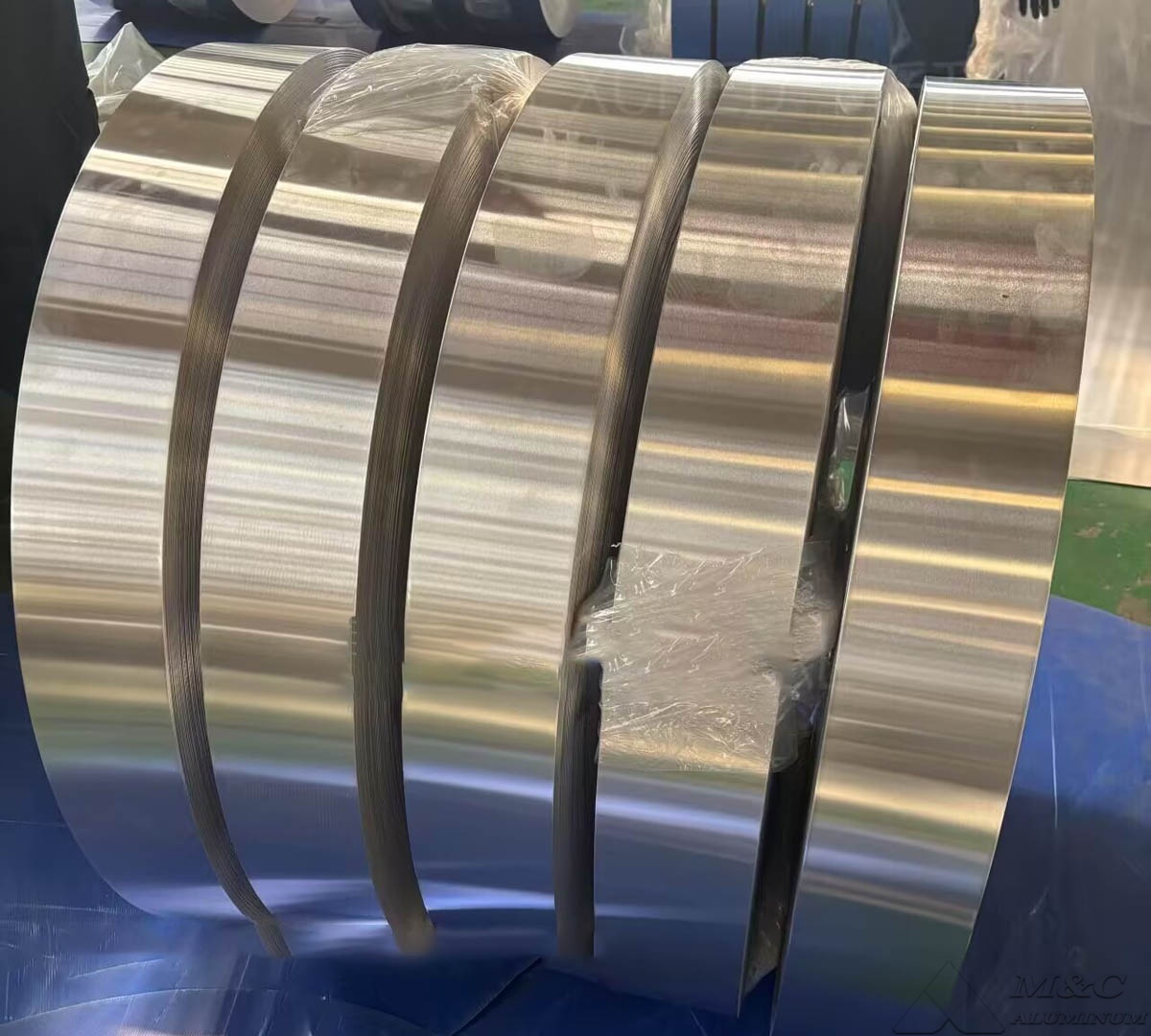
Surface and Edge Quality Requirements
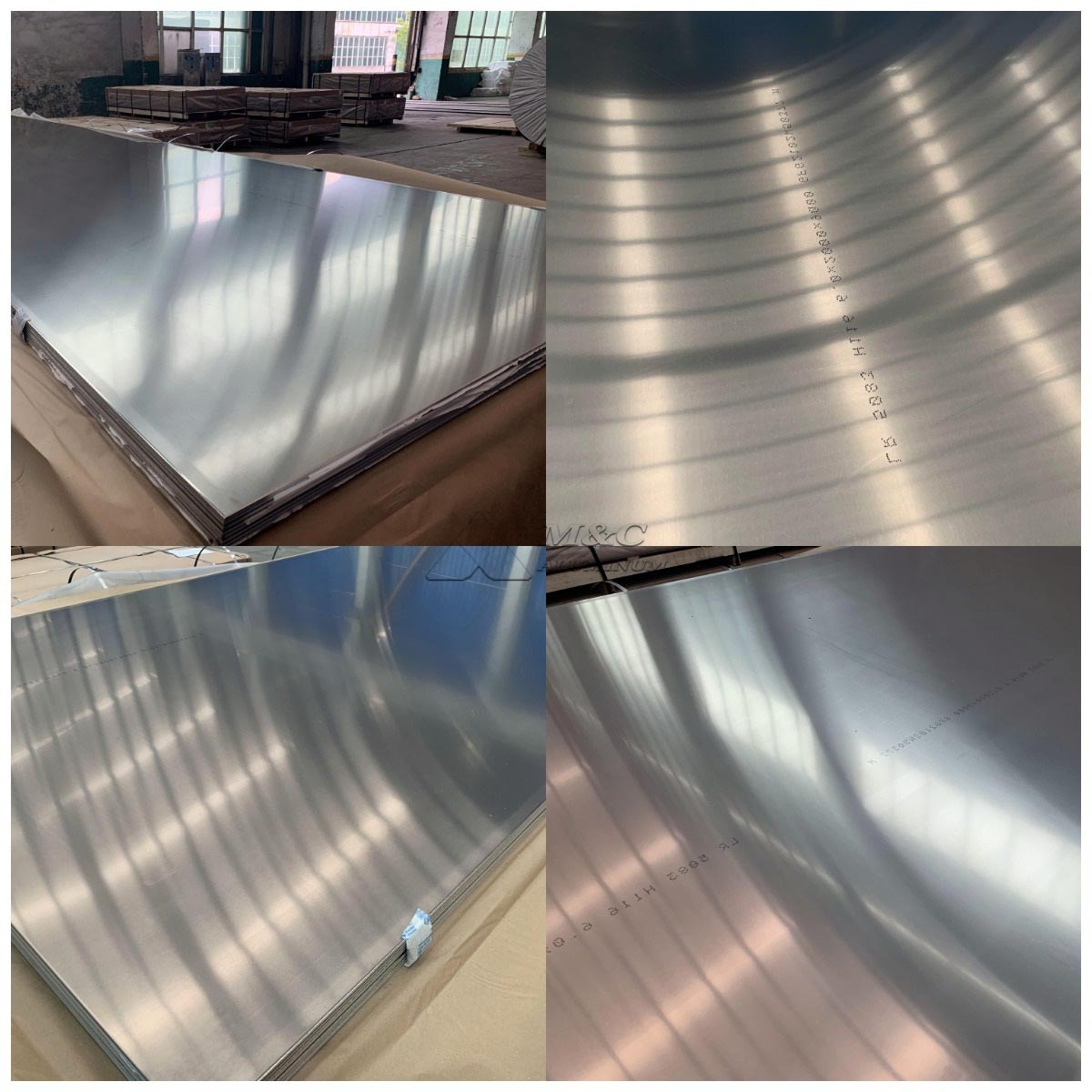
For aluminum strip for power cable armoring, surface quality must meet both mechanical and processing requirements. The surface should be clean and free from defects that may affect wrapping or forming. Minor mill marks may be acceptable depending on the agreed standard, but deep scratches, dents, heavy oil, oxide patches, or embedded foreign matter should be avoided.
Edge quality is especially important. Burrs or cracked edges can damage cable sheath materials, create production interruptions, or reduce the reliability of the armor layer. We inspect edge condition during and after slitting. When required, we can provide controlled burr direction, reduced burr edge, or additional edge conditioning. Customers may specify maximum burr height and edge camber limits based on their equipment.
Coil winding is also inspected. A stable coil should be compact, aligned, and suitable for high-speed unwinding. Poor winding may cause strip overlap, tension fluctuation, or strip breakage during cable armoring. Our packaging method is selected to protect coil edges during container loading, sea transport, and warehouse handling.
Mechanical Properties and Application Matching
Cable armoring requirements vary according to cable type. A small control cable may require different strip behavior from a large power cable. Some designs require higher elongation for forming, while others require higher tensile strength for mechanical protection. For this reason, we do not treat all aluminum armor strip as one standard product. We confirm the cable structure and operating process before recommending alloy and temper.
Soft O temper aluminum strip provides excellent ductility and is suitable for applications requiring strong forming capability. H12 and H14 tempers provide a balance between formability and strength. H16 and H18 tempers provide higher strength but require suitable forming conditions to avoid cracking. 3003 aluminum strip is often selected when additional strength is required compared with commercially pure aluminum grades. For customers evaluating manganese alloy strip, our 3003 Aluminium strip production can be specified for cable protection and other industrial uses.
Dimensional Control for Stable Cable Production
Accurate thickness and width are not only purchasing parameters. They directly influence cable diameter, armor overlap, final cable weight, and production efficiency. If thickness is unstable, the finished cable may have uneven mechanical properties or inconsistent outer diameter. If width variation is excessive, the armor coverage and overlap may not meet design requirements.
Our inspection team checks thickness across the coil width and along the coil length. Width is measured after slitting, and edge camber is monitored for narrow strip products. For export customers, we can provide inspection records with each shipment when required. If the customer has a specific cable standard or in-house tolerance table, we can review it before production and confirm manufacturability.
Quality Control and Testing
Quality control is performed at several stages, including incoming material inspection, rolling inspection, annealing verification, slitting inspection, and final product approval. Our testing can include chemical composition, tensile strength, elongation, thickness, width, surface inspection, edge condition, coil winding, and packaging confirmation.
| Quality Control Item | Inspection Purpose |
|---|---|
| Chemical composition | Confirms alloy grade and compliance with order requirement |
| Tensile strength | Verifies temper and mechanical performance |
| Elongation | Confirms forming suitability during armoring process |
| Thickness measurement | Controls cable design weight and armor layer consistency |
| Width measurement | Ensures correct overlap and machine compatibility |
| Edge inspection | Reduces risk of burr-related damage and strip breakage |
| Surface inspection | Prevents harmful defects, oil, stains, and foreign matter |
| Coil winding check | Ensures safe unwinding and stable customer production |
| Packaging inspection | Protects coils during long-distance export transportation |
Packaging and Export Delivery
Aluminum strip for power cable armoring must be protected from moisture, impact, and edge damage during export. We normally pack coils with moisture-proof wrapping, protective paper or film, edge guards, steel or plastic strapping, and strong wooden pallets or wooden cases. The packing design depends on coil size, gross weight, shipping method, and unloading conditions at the customer plant.
Each coil is labeled clearly. Packing lists and commercial documents can be prepared according to export requirements. When necessary, we can coordinate third-party inspection before shipment. Our aim is to ensure that the aluminum strip arrives in stable condition and can be placed into cable production with minimal handling risk.
Information Needed for Quotation
To provide an accurate quotation and production proposal, we recommend that customers send the required alloy, temper, thickness, width, coil inner diameter, coil outer diameter or coil weight, edge requirement, surface requirement, quantity, and applicable standard. If the product is used on a specific cable armoring machine, details such as unwinding method, maximum coil weight, and required burr direction are also useful.
For new cable projects, samples or trial coils can be produced after technical confirmation. Trial production helps confirm strip behavior during wrapping, forming, or corrugation before larger batch orders. For repeat orders, we maintain production records to support consistency between shipments.
Manufacturer Commitment to Consistent Supply
As a manufacturer of aluminum strip for power cable armoring, our responsibility is to provide material that meets agreed technical requirements, not only to deliver coils by weight. Cable manufacturers depend on reliable strip performance because aluminum armor is integrated into continuous cable production. Stable alloy composition, controlled temper, precise slitting, clean surface, and protective packaging all contribute to efficient cable manufacturing.
We support international B2B customers with customized aluminum cable armor strip for power cable, control cable, and related electrical cable applications. By controlling production inside our factory and communicating technical details before order confirmation, we help customers select suitable aluminum strip for their cable structures and production conditions.
Contact Us