
5052 and 5154 Aluminum Strips for Communication Cables
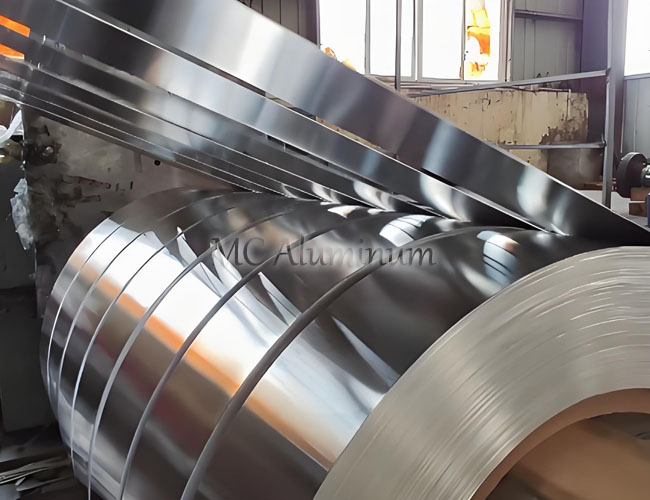
As an aluminum rolling and slitting manufacturer, we produce 5052 and 5154 aluminum strips for communication cable applications where stable mechanical performance, corrosion resistance, clean surfaces, and consistent coil geometry are required. These aluminum-magnesium alloy strips are widely used in cable shielding layers, protective armoring, moisture barrier structures, and corrugated or longitudinal wrapping systems for telecom, data transmission, optical fiber, and signal cables.
Communication cable manufacturers need aluminum strip that can run continuously on high-speed forming, wrapping, and welding or bonding lines. For this reason, the strip must have controlled tensile strength, uniform elongation, accurate thickness, smooth edges, low burr, and reliable coil winding. Our production focuses on these processing requirements rather than only nominal alloy grades.
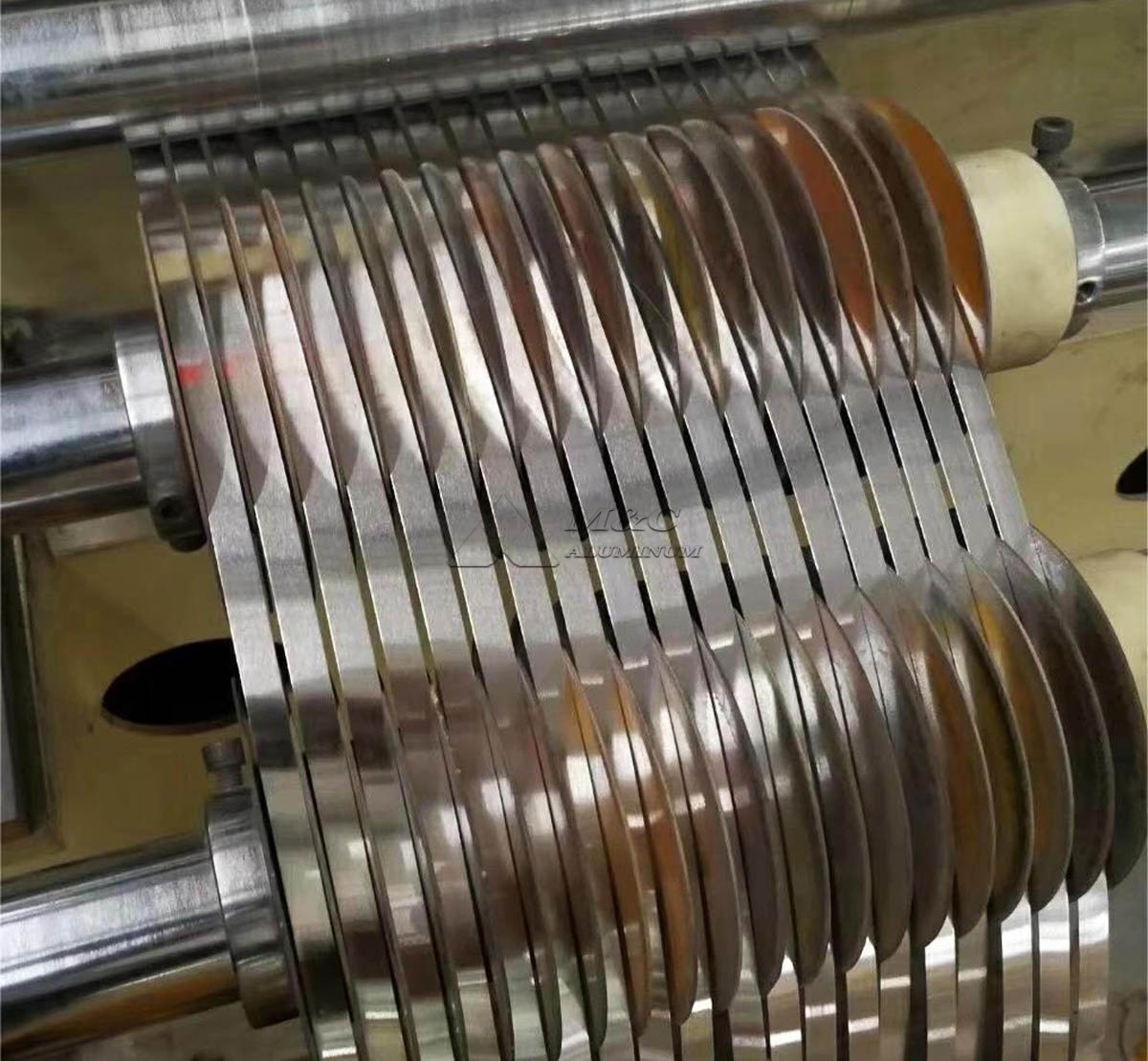
Why 5052 and 5154 Aluminum Strips Are Used in Communication Cables
5052 aluminum strip and 5154 aluminum strip belong to the Al-Mg alloy series. Compared with pure aluminum grades, they provide higher strength and better resistance to atmospheric corrosion, moisture, and many industrial environments. Compared with heavier metallic shielding materials, aluminum strip provides a favorable balance of conductivity, weight reduction, formability, and cost efficiency.
In communication cables, aluminum strip can perform several functions. It may act as an electromagnetic shielding layer to reduce external interference. It may also be used as a mechanical protection layer, especially in corrugated or wrapped cable designs. In some structures, aluminum strip is combined with polymer films to form a laminated barrier against moisture ingress. The selection of 5052 or 5154 depends on cable design, forming method, required strength, and service environment.
5052 is commonly selected when balanced formability, corrosion resistance, and medium strength are needed. 5154 has a slightly higher magnesium content and can provide higher strength, making it suitable for cable designs requiring stronger armoring performance or improved resistance to deformation during installation.
Typical Applications in Cable Manufacturing
Our 5052 and 5154 aluminum strips are supplied for multiple communication cable structures, including:
Aluminum strip for optical fiber cable armoring
Aluminum strip for telecom cable shielding
Aluminum strip for RF and signal cable protection
Corrugated aluminum strip for communication cable sheathing
Laminated aluminum strip for moisture barrier layers
Longitudinally wrapped aluminum strip for underground or outdoor cables
Aluminum-magnesium alloy strip for coastal or humid service environments
The final cable structure determines the required temper, strip width, thickness tolerance, surface condition, and edge quality. For example, corrugated armoring requires good ductility and uniform deformation, while shielding applications often require stable width tolerance, clean surface, and reliable electrical continuity.
Alloy Characteristics of 5052 and 5154
Both 5052 and 5154 are non-heat-treatable aluminum alloys strengthened mainly by magnesium and cold working. They can be supplied in soft, semi-hard, or hard tempers according to cable processing requirements. Their properties remain stable under normal service conditions, and they are suitable for outdoor cable systems that may face rain, humidity, temperature variation, and installation stress.
The following table lists typical chemical composition ranges for reference. Final supply can follow ASTM, EN, or customer-specified standards.
| Alloy | Mg | Mn | Cr | Fe | Si | Cu | Zn | Al |
|---|---|---|---|---|---|---|---|---|
| 5052 | 2.2-2.8 | 0.10 max | 0.15-0.35 | 0.40 max | 0.25 max | 0.10 max | 0.10 max | Balance |
| 5154 | 3.1-3.9 | 0.10 max | 0.15-0.35 | 0.40 max | 0.25 max | 0.10 max | 0.20 max | Balance |
The higher magnesium content of 5154 usually provides increased strength compared with 5052. However, the final mechanical values are also affected by rolling reduction, annealing process, and ordered temper.
Technical Parameters for Cable Aluminum Strip
We manufacture aluminum strip for communication cables according to order drawings and processing conditions. The following parameters represent common supply ranges. Special specifications can be discussed during technical review before production.
| Item | 5052 Aluminum Strip | 5154 Aluminum Strip | Notes |
|---|---|---|---|
| Typical thickness | 0.15-1.20 mm | 0.20-1.50 mm | Customized thickness available |
| Typical width | 10-600 mm | 10-600 mm | Slit width based on cable design |
| Temper | O, H12, H14, H16, H18, H24, H32 | O, H12, H14, H16, H18, H24, H32 | Selected by forming requirement |
| Tensile strength | Approx. 170-290 MPa | Approx. 210-330 MPa | Depends on temper and thickness |
| Elongation | Approx. 3-20 percent | Approx. 3-18 percent | Higher in soft tempers |
| Thickness tolerance | According to order standard | According to order standard | Tight tolerance available by agreement |
| Edge condition | Slit edge, deburred edge optional | Slit edge, deburred edge optional | Low burr for high-speed wrapping |
| Surface | Mill finish, clean and oil-controlled | Mill finish, clean and oil-controlled | Coating or lamination support by request |
| Coil ID | 150, 200, 300, 400, 508 mm | 150, 200, 300, 400, 508 mm | Other IDs by agreement |
| Coil weight | As agreed | As agreed | Based on line capacity and handling |
5052 Aluminum Strip for Communication Cables
5052 aluminum strip is frequently used where the cable manufacturer requires good ductility, corrosion resistance, and stable processing on continuous production lines. It is suitable for wrapping, forming, light corrugation, and laminated barrier applications. In many communication cable designs, 5052 provides sufficient mechanical protection while keeping the cable weight under control.
For cable shielding aluminum strip, 5052 can be supplied with controlled surface cleanliness to support bonding with polymer films or adhesives. For armoring applications, a suitable temper must be selected to avoid cracking during corrugation or excessive springback during wrapping. In our production, temper control is managed through cold rolling and annealing schedules, followed by mechanical property testing before release.
When customers require higher elongation for complex forming, 5052-O or 5052-H24 may be considered. When higher strength and shape stability are more important, 5052-H16 or 5052-H18 can be selected after confirming the forming radius and line speed.
5154 Aluminum Strip for Communication Cables
5154 aluminum strip is selected when higher strength is required in the cable protective layer. It is suitable for communication cables installed outdoors, underground, in ducts, or in locations where cable compression, bending, and installation stress may be higher. The alloy maintains good corrosion resistance, especially in humid or marine-influenced environments.
Compared with 5052, 5154 generally offers improved strength due to its higher magnesium content. This makes it useful for armoring structures that must resist mechanical damage while keeping the cable lighter than steel-armored alternatives. However, because higher strength can reduce formability in some tempers, the selection of 5154 should be coordinated with the cable forming process. We usually review thickness, temper, corrugation depth, wrapping angle, and required bending performance before confirming production.
For cable manufacturers using high-speed lines, 5154 aluminum strip must have stable coil tension and uniform edge quality. Uneven slit edges or excessive burr may cause film damage, forming instability, or line stoppage. Our slitting process is adjusted according to alloy hardness, thickness, and final width to control these risks.
Manufacturing Process in Our Factory
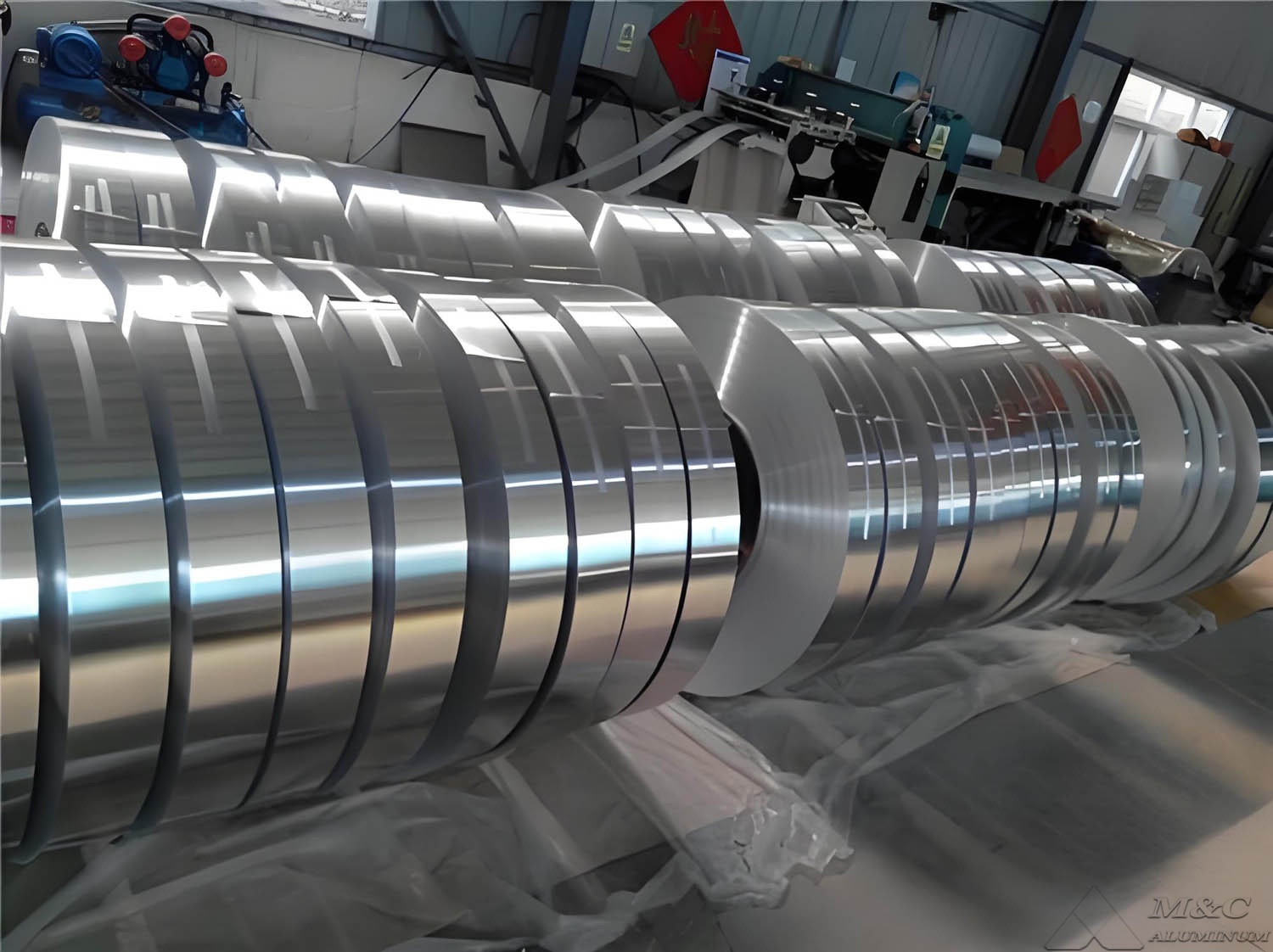
Our production route is designed to ensure stable performance from raw material to finished aluminum strip coils. The typical process includes melting or slab sourcing according to alloy requirements, hot rolling, cold rolling, intermediate annealing when required, final rolling, tension leveling, slitting, inspection, packing, and shipment.
Cold rolling controls the final thickness and mechanical properties. Annealing adjusts ductility and reduces internal stress. Tension leveling improves flatness, which is important for longitudinal wrapping and lamination. Slitting determines the final strip width and edge condition. Each step is controlled by production records and inspection data.
For communication cable aluminum strip, we pay particular attention to three manufacturing points. First, thickness consistency must remain stable across the coil length to avoid forming variation. Second, surface cleanliness must meet cable bonding or insulation requirements. Third, coil winding must be tight and even, with no telescoping, edge collapse, or severe coil deformation during transport.
Surface and Edge Quality Requirements
Cable production is continuous, and small defects can affect line efficiency. Surface defects such as heavy oil marks, scratches, black spots, dents, or oxidation stains may influence bonding, shielding contact, or product appearance. Therefore, the surface of 5052 and 5154 aluminum strips for communication cables is inspected before packing.
Edge quality is also critical. Burrs can damage polymer layers, reduce insulation reliability, or create instability during wrapping. For narrow aluminum strip, edge camber and width tolerance must be controlled carefully. We can provide standard slit edges or improved deburred edges according to customer requirements. For laminated structures, surface oil control can also be specified to support stable adhesion.
Quality Control and Testing
As a manufacturer, we test and document key properties before delivery. Inspection methods may be adjusted according to customer standards, but our regular quality control includes dimensional inspection, mechanical property testing, surface inspection, edge inspection, and coil condition assessment.
| Inspection Item | Control Purpose | Common Method |
|---|---|---|
| Chemical composition | Confirm alloy grade | Spectrometer analysis |
| Thickness and width | Ensure cable line compatibility | Micrometer, width gauge |
| Tensile strength | Confirm temper and strength level | Tensile testing machine |
| Elongation | Verify forming suitability | Tensile test result |
| Surface quality | Prevent bonding or wrapping defects | Visual and process inspection |
| Burr and edge condition | Reduce cable layer damage | Edge inspection, burr measurement |
| Coil winding | Ensure safe handling and smooth unwinding | Visual and dimensional check |
Traceability is maintained through coil numbers, production records, and inspection reports. When required, we can provide mill test certificates with chemical composition, mechanical properties, and dimensional results.
Selection Guidelines: 5052 or 5154
The choice between 5052 aluminum strip and 5154 aluminum strip should be based on engineering requirements rather than grade preference alone. If the cable design requires balanced forming and corrosion resistance, 5052 is often suitable. If the design requires higher strength or more robust mechanical protection, 5154 may be the better option.
For corrugated cable armoring, soft or semi-hard tempers are generally preferred to reduce cracking risk. For longitudinal wrapping with limited forming deformation, harder tempers may be acceptable. For laminated shielding, surface cleanliness, thickness tolerance, and bonding compatibility may be more important than maximum strength.
Before mass production, we recommend confirming the following data:
Cable type and service environment
Aluminum strip thickness and width
Required alloy and temper
Forming method, such as wrapping, corrugation, or lamination
Required tensile strength and elongation
Coil inner diameter and maximum coil weight
Surface oil level, coating, or film bonding requirements
Packaging and export handling conditions
These details allow us to match the production process to the actual cable manufacturing line.
Packaging for Export Supply
Finished aluminum strip coils are packed to protect the surface and coil shape during storage and international transportation. Standard export packaging may include moisture-proof paper, plastic film, edge protection, steel or plastic strapping, wooden pallets, and outer protective covers. For narrow strips or soft tempers, additional side protection can be used to reduce the risk of edge damage.
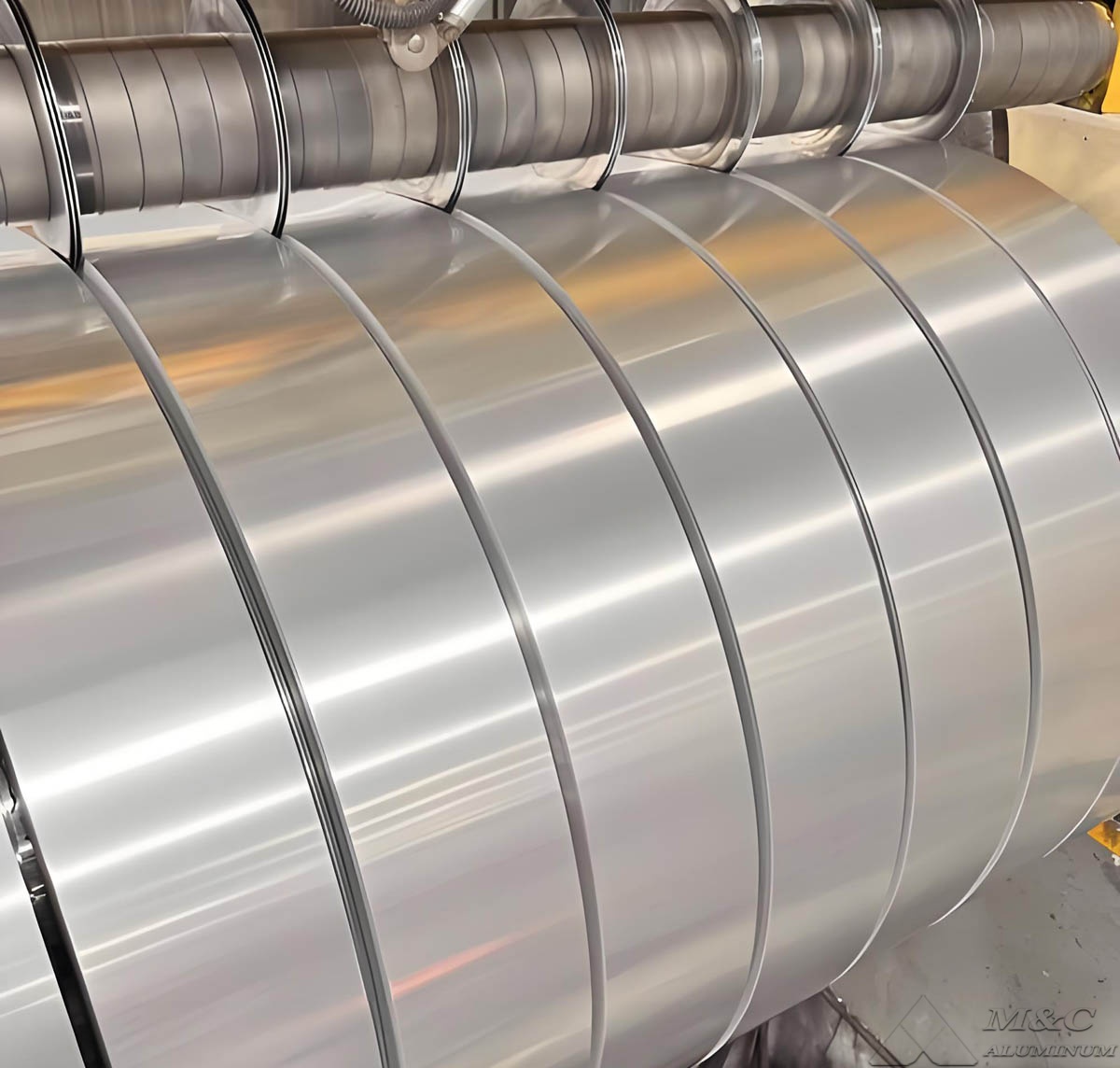
Coils are labeled with alloy, temper, size, coil number, net weight, gross weight, and production reference. Packaging can be adjusted for container loading, warehouse handling, or direct feeding to customer production lines.
Conclusion
5052 and 5154 aluminum strips are reliable aluminum-magnesium alloy materials for communication cable shielding, armoring, and moisture barrier applications. 5052 offers a balanced combination of formability, corrosion resistance, and medium strength, while 5154 provides higher strength for more demanding cable protection designs.
As an aluminum strip manufacturer, we supply these materials with controlled alloy composition, temper, thickness, width, surface condition, edge quality, and coil packaging. By matching the strip specification to the cable production process, manufacturers can improve line stability, reduce processing defects, and achieve consistent cable performance in outdoor, underground, and industrial communication networks.
Contact Us