
High-Quality 5052 Aluminum Strip for Industrial Transformers
As a manufacturer of rolled aluminum materials, we produce high-quality 5052 aluminum strip for industrial transformers with strict control over alloy composition, dimensional tolerance, surface condition, and mechanical consistency. In transformer production, material stability directly affects winding performance, insulation coordination, forming efficiency, and long-term service reliability. For this reason, the selection of aluminum strip must be based not only on nominal alloy grade, but also on process capability and quality control at the manufacturing source.
Our 5052 aluminum strip is produced for industrial applications that require a combination of moderate strength, good formability, stable conductivity, and strong corrosion resistance. Compared with commercially pure aluminum grades, 5052 alloy offers higher mechanical strength while maintaining good workability, making it suitable for selected transformer components, structural conductive parts, shielding elements, and auxiliary strip applications in demanding industrial environments.
Why 5052 Aluminum Strip Is Used in Industrial Transformers
5052 is an aluminum-magnesium alloy known for its good balance of strength, ductility, weldability, and resistance to moisture and industrial atmospheres. In transformer manufacturing, not every strip application requires the highest electrical conductivity. In many cases, the design priority is a combination of conductivity, mechanical integrity, dimensional stability, and resistance to corrosion during storage and service.
For these conditions, 5052 aluminum strip provides several practical advantages:
Higher strength than 1xxx series aluminum strip
Good bending and forming performance
Strong resistance to corrosion in humid and industrial environments
Stable surface quality for insulation and further processing
Reliable performance in slit strip and coil form
Suitability for precision fabrication of industrial components
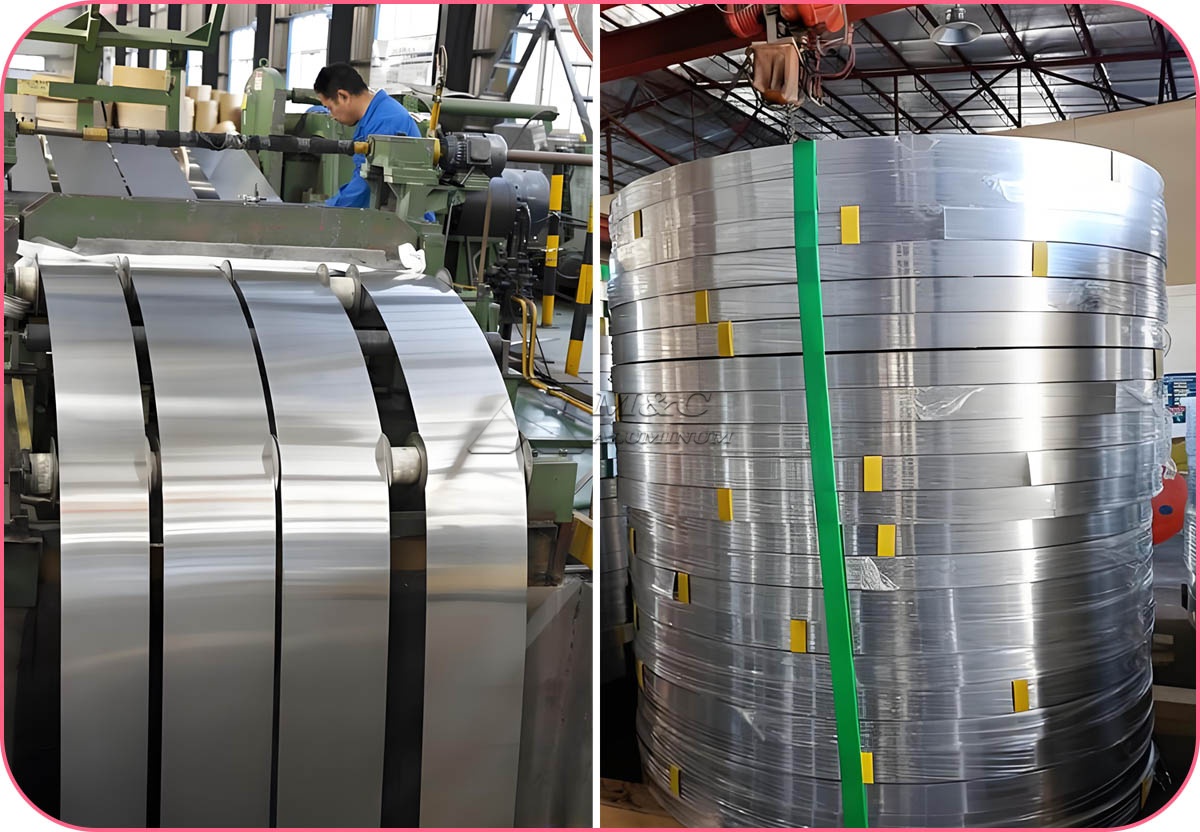
In our factory, we process 5052 aluminum strip from ingot casting through hot rolling, cold rolling, annealing, slitting, and final inspection. This integrated production route allows us to maintain consistency from coil to coil, which is especially important for customers producing transformer parts at scale.
Our Manufacturing Control for 5052 Aluminum Strip
As a direct manufacturer, we control the key production stages that determine final strip quality. This is essential for industrial transformer customers who require repeatable processing behavior and dependable batch uniformity.
Alloy and Melt Control
We begin with controlled melt preparation to ensure the magnesium content and impurity levels remain within specification. Stable chemistry is the foundation for mechanical consistency, corrosion performance, and uniform rolling behavior.
Rolling Precision
During hot and cold rolling, we control thickness reduction schedules to achieve the required gauge accuracy and flatness. Transformer manufacturers often require strip with smooth edges, minimal wave, and controlled residual stress, especially for automated winding or forming lines.
Heat Treatment and Temper Control
5052 aluminum strip is available in different tempers depending on the intended application. We adjust annealing parameters to achieve the target balance of hardness, elongation, and formability. This helps customers maintain stable downstream forming results.
Slitting and Surface Inspection
For precision strip products, edge quality is a critical factor. Our slitting lines are configured to reduce burr, edge deformation, and camber. Surface inspection is performed to identify scratches, oil contamination, roll marks, and other defects that may affect insulation systems or assembly quality.
Customers looking for broader specifications can also review our Aluminum Strip production capabilities for multiple alloys and industrial uses.
Technical Parameters of Our 5052 Aluminum Strip
The following table shows the typical supply range for our 5052 aluminum strip for industrial transformer applications. Specific values can be adjusted according to customer drawings and processing requirements.
| Item | Specification |
|---|---|
| Alloy | 5052 |
| Temper | O, H14, H16, H18, H24, H32 |
| Thickness | 0.15 mm - 6.00 mm |
| Width | 10 mm - 1600 mm |
| Coil ID | 150 mm, 300 mm, 400 mm, 500 mm, 508 mm |
| Coil OD | According to weight and packaging requirement |
| Thickness tolerance | According to agreed standard or customer requirement |
| Width tolerance | Precision slitting available |
| Surface | Smooth, clean, without serious scratches, oil stain, corrosion, or edge defects |
| Edge condition | Mill edge or slit edge |
| Standard | ASTM, EN, GB, or customer specification |
| Electrical conductivity | Lower than 1xxx series, suitable for non-pure-conductor applications |
| Corrosion resistance | Excellent in humid and industrial environments |
| Processing method | Casting, hot rolling, cold rolling, annealing, slitting |
| Packaging | Export seaworthy wooden pallet or wooden case |
Typical Applications in Industrial Transformers
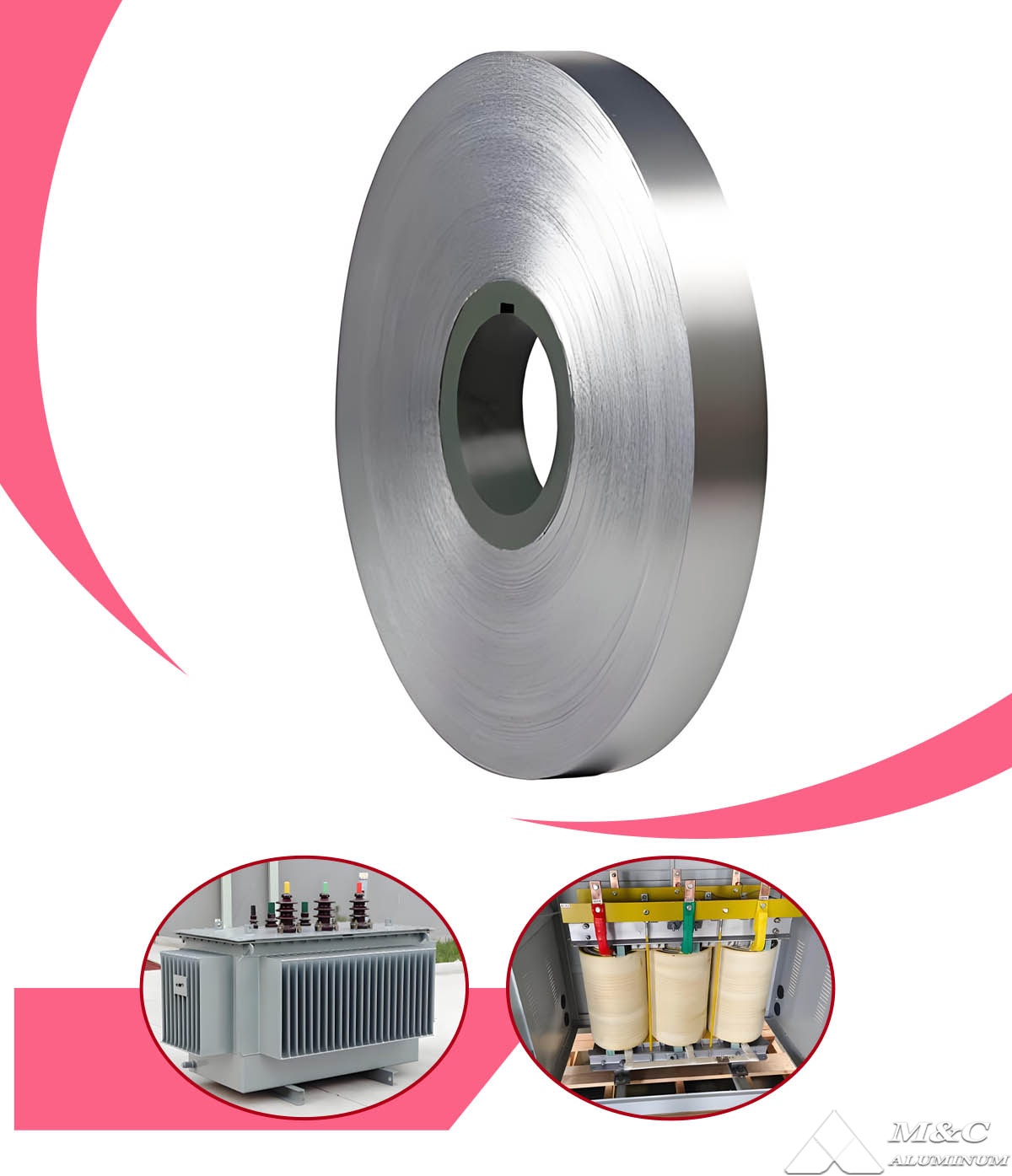
Although 1xxx series alloys are widely used where maximum conductivity is required, 5052 aluminum strip is selected in industrial transformers when structural performance and environmental resistance are equally important. Based on customer production requirements, our material is used in the following areas:
Winding-Related Auxiliary Components
For certain transformer designs, 5052 alloy strip can be used in non-primary conductive positions where mechanical strength, forming stability, and corrosion resistance are required. Its balanced properties support stable fabrication and assembly.
Shielding and Structural Parts
Industrial transformers often include metal strip components used for shielding, clamping support, covers, and formed auxiliary parts. In these applications, 5052 aluminum strip provides good stiffness and workability.
Insulation System Interfaces
Where strip material interfaces with insulation layers, surface cleanliness and smoothness are important. We supply material with controlled surface quality to support further coating, laminating, wrapping, or assembly.
Equipment Used in Harsh Environments
For transformers operating in coastal, humid, or chemically active industrial environments, corrosion resistance becomes a key material selection factor. 5052 alloy is widely recognized for this advantage.
Key Quality Requirements for Transformer Aluminum Strip
In our production experience, customers in the transformer industry focus on more than basic alloy certification. The following quality points are often critical in actual manufacturing:
Dimensional Accuracy
Stable thickness and width help ensure predictable forming, assembly clearance, and process efficiency. We produce precision slit 5052 aluminum strip for customers with narrow tolerance requirements.
Flatness and Coil Shape
Poor flatness can lead to feeding instability, uneven winding tension, or difficulty in forming operations. Our process control is designed to improve coil geometry and reduce shape defects.
Edge Quality
Burr and edge cracking can affect insulation safety and downstream handling. For transformer applications, we pay close attention to slit edge integrity.
Surface Consistency
A clean and uniform surface helps reduce the risk of insulation damage and improves product appearance after fabrication. This is especially important for customers applying insulating layers or performing precision assembly.
Mechanical Stability
The strip must respond consistently during bending, stamping, and forming. Our temper control helps customers maintain repeatable results in serial production.
For applications specifically centered on winding-grade products, customers may also refer to our Transformer Aluminium Strip range for additional alloy options and technical configurations.
How We Support OEM and Industrial Buyers
As a factory, we work directly with transformer manufacturers, electrical equipment plants, and industrial component processors. Our supply service is based on production requirements rather than general trading specifications.
We support customers with:
Coil and slit strip supply in custom dimensions
Temper selection according to forming and strength requirements
Mill edge or slit edge delivery
Controlled inner diameter and coil weight
Surface quality confirmation before shipment
Batch traceability and material certification
Export packaging suitable for long-distance transport
When customers provide processing details such as bending radius, winding method, insulation structure, or operating environment, we can recommend an appropriate supply condition for the 5052 aluminum strip. This manufacturer-based approach helps reduce mismatch between material properties and actual application needs.
5052 vs. 1xxx Series for Transformer Use
From a factory perspective, alloy selection should match the function of the strip inside the transformer system. If the highest electrical conductivity is the primary requirement, 1050, 1060, or 1070 transformer aluminum strip may be more suitable. If the application requires better strength, better corrosion resistance, and stronger structural performance, 5052 aluminum strip can be the more practical choice.
This distinction is important because industrial transformers often contain multiple aluminum components with different performance priorities. A single alloy does not fit every position. Our role as a manufacturer is to supply the alloy and temper that best correspond to the actual service condition and fabrication process.
Packaging, Inspection, and Export Delivery
For international customers, packaging reliability is an important part of product quality. We package 5052 aluminum strip with moisture protection, anti-collision measures, and seaworthy support materials to reduce transit risk.
Before shipment, our inspection process typically covers:
Alloy verification
Thickness and width measurement
Surface visual inspection
Edge condition check
Coil weight confirmation
Packaging inspection
Document review for traceability
This process helps ensure that the aluminum strip received by the customer is ready for direct production use.
Conclusion
High-quality 5052 aluminum strip for industrial transformers must combine stable alloy composition, accurate dimensions, controlled temper, clean surface, and reliable edge quality. As a manufacturer, we produce 5052 alloy strip under integrated rolling and slitting control so that transformer manufacturers can obtain material suited to demanding industrial processing and service conditions.
For transformer applications where corrosion resistance, mechanical strength, and fabrication stability are important, 5052 aluminum strip is a practical and dependable choice. By supplying directly from our factory, we help customers achieve better consistency, clearer technical communication, and more reliable batch performance in industrial transformer production.
Contact Us