
Application and Importance of Transformer Aluminum Strip
As an aluminum processing factory, we manufacture transformer aluminum strip for electrical winding applications where conductivity, dimensional accuracy, surface quality, and stable mechanical performance are essential. Transformer aluminum strip is not a general-purpose strip material. It is a functional conductor used in distribution transformers, dry-type transformers, oil-immersed transformers, reactors, inductors, and other electrical equipment. Its quality directly influences winding efficiency, temperature rise, insulation reliability, and long-term transformer service life.
In international transformer manufacturing, aluminum strip is widely used as an economical and technically reliable alternative to copper in many medium and low voltage designs. With proper alloy selection, controlled annealing, precise slitting, and clean packaging, aluminum winding strip can meet strict requirements for electrical performance and production stability.
What Is Transformer Aluminum Strip?
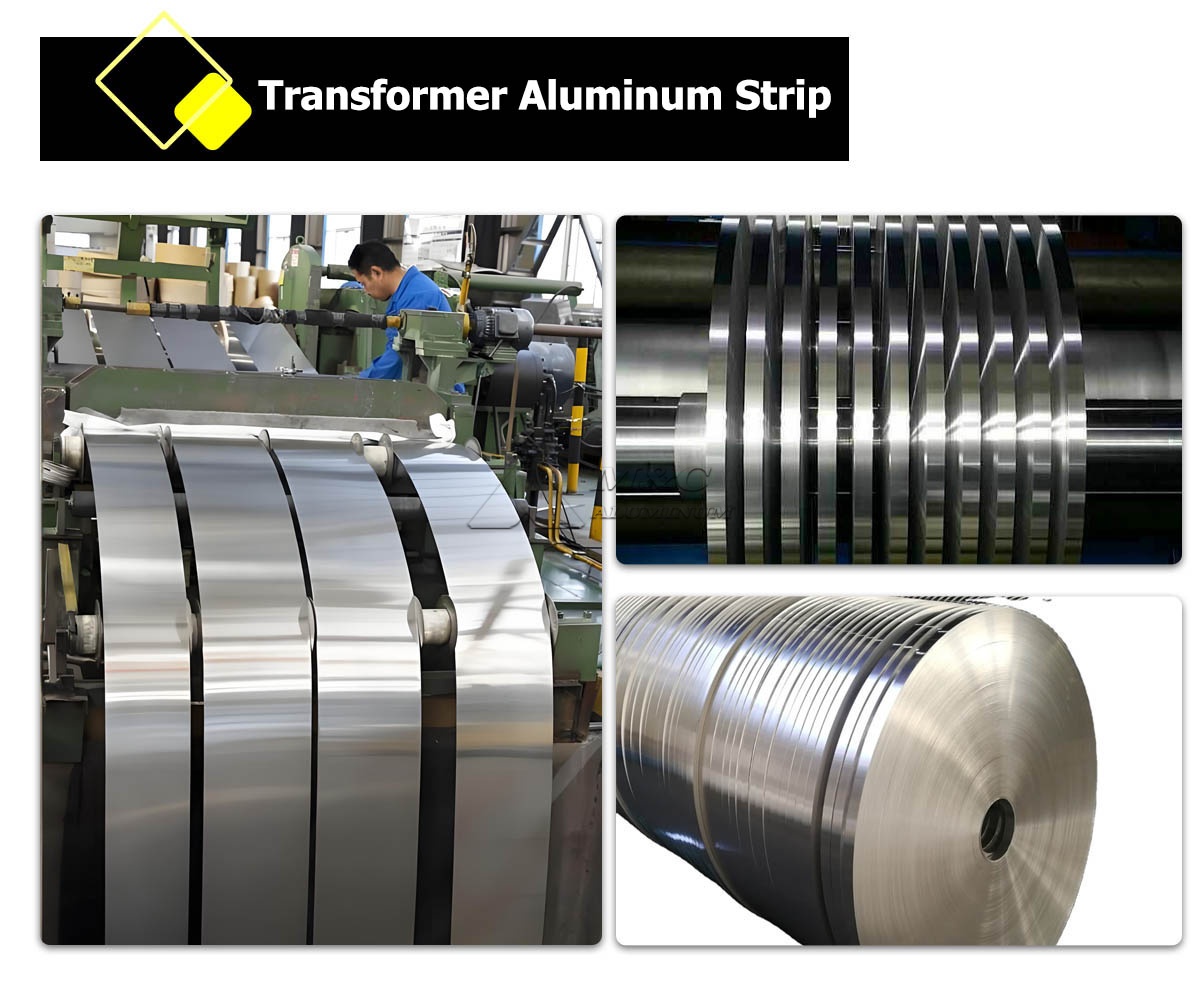
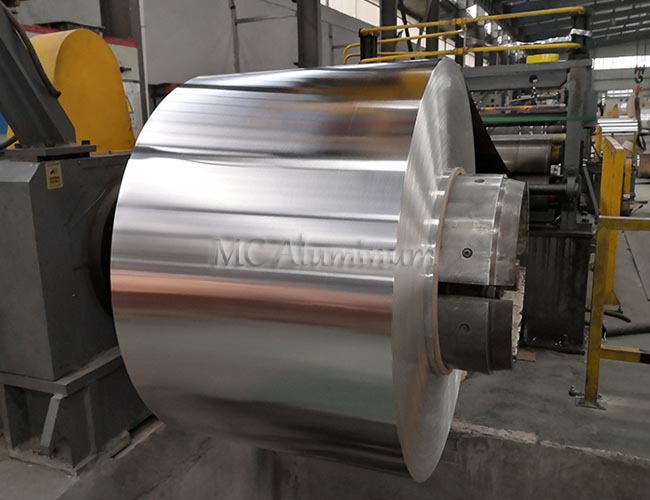
Transformer aluminum strip is a flat aluminum conductor supplied in coil form for transformer winding. It is typically produced from high-purity aluminum alloys such as 1050, 1060, 1070, 1350, or other electrical-grade aluminum materials. The strip is rolled to a specified thickness, slit to the required width, edge-treated if necessary, annealed to the target temper, and packed for protection during long-distance transportation.
Compared with standard industrial Aluminum Strip, transformer aluminum strip requires stricter control of burr height, edge shape, conductivity, surface cleanliness, and coil winding quality. These factors affect insulation paper wrapping, winding tension, layer alignment, and partial discharge risk in the finished transformer.
For our production, the main focus is not only meeting nominal size requirements, but also ensuring consistency along the full coil length. A stable strip coil helps transformer manufacturers reduce stoppages, insulation damage, and winding defects during automatic or semi-automatic winding.
Main Applications of Transformer Aluminum Strip
1. Distribution Transformer Windings
Distribution transformers are one of the most common applications for aluminum winding strip. In low voltage windings, aluminum strip can provide sufficient current-carrying capacity while reducing material cost and total transformer weight. When designed correctly, transformer aluminum strip supports efficient heat dissipation and stable electrical operation.
For this application, strip width and thickness are selected according to transformer capacity, current density, and insulation structure. The surface must be smooth and free from oil stains, scratches, cracks, and metal particles that may damage insulation materials.
2. Dry-Type Transformer Windings
Dry-type transformers require excellent insulation reliability because they are often installed in buildings, industrial facilities, data centers, and public infrastructure. Aluminum strip for dry-type transformer winding must have consistent dimensions and clean surfaces to ensure uniform resin impregnation or encapsulation.
In dry-type transformer production, edge quality is especially important. Excessive burrs or sharp edges can increase the risk of insulation breakdown. Our slitting process is controlled to minimize burr formation and maintain a safe, uniform edge profile.
3. Oil-Immersed Transformer Windings
Oil-immersed transformers use insulating oil for cooling and insulation. Aluminum strip used in these transformers must be compatible with winding paper, insulating oil, and thermal expansion behavior during operation. The strip should have stable mechanical properties so that it can withstand winding tension without deformation or edge cracking.
Because oil-immersed transformers may operate for decades, conductor quality is closely related to long-term reliability. Uniform conductivity and proper temper control help reduce abnormal heating and improve load performance.
4. Reactors, Inductors, and Electrical Coils
Beyond transformer windings, aluminum strip is also used in reactors, chokes, inductors, and other electrical coil products. These applications may require customized dimensions, controlled elongation, and precise coil weight. We supply strip coils according to drawing requirements and end-use process conditions.
For customers requiring a dedicated conductor product, our Transformer Aluminium Strip is manufactured with electrical applications in mind, including alloy purity, slitting precision, coil flatness, and protective packaging.
Why Transformer Aluminum Strip Is Important
Electrical Conductivity and Energy Efficiency
The conductor is a central component of transformer performance. Aluminum has lower density than copper, and although its conductivity is lower on a volume basis, it offers strong advantages in weight, cost, and process flexibility. By using suitable cross-sectional area and high-purity alloys, aluminum strip can achieve reliable current transmission in many transformer designs.
High conductivity reduces conductor loss and helps control temperature rise. For this reason, transformer aluminum strip is commonly produced from alloys with excellent electrical properties, such as 1060, 1070, and 1350. Conductivity should be tested and verified according to relevant standards or customer specifications.
Dimensional Accuracy for Winding Stability
Transformer winding requires accurate conductor dimensions. Thickness variation affects resistance, winding height, and cooling channel consistency. Width variation influences layer alignment and insulation coverage. If the strip is unstable in dimension, the winding process may produce uneven coils, higher loss, or assembly difficulty.
As a manufacturer, we control rolling thickness tolerance and slitting width tolerance through calibrated equipment and in-process inspection. For many transformer factories, dimensional consistency is just as important as the nominal tolerance value.
Surface Quality and Insulation Safety
Transformer aluminum strip is usually combined with kraft paper, NOMEX, polyester film, or other insulation materials. Surface defects can damage these materials during winding. Scratches, dents, rolling marks, oil residue, or metal chips may become weak points in the insulation system.
Our production control includes surface inspection, cleaning control, coil protection, and careful packaging. The goal is to deliver aluminum winding strip that can be used smoothly on customer winding equipment with minimal surface-related rejection.
Edge Quality and Burr Control
The edge of transformer aluminum strip is a critical quality area. Burrs may cut insulation paper or cause local electrical stress. Edge waves may affect coil flatness and winding tension. Uneven edges may also create gaps or pressure concentration in the winding structure.
During slitting, blade clearance, blade sharpness, strip tension, and recoiling alignment must be controlled. For transformer applications, we pay close attention to burr height, edge straightness, and coil telescoping. When required, edge conditioning can be discussed according to the customer's winding process.
Common Technical Parameters
The following table shows typical manufacturing parameters for transformer aluminum strip. Final values should be confirmed according to transformer design, applicable standards, and customer drawings.
| Item | Typical Specification | Notes |
|---|---|---|
| Alloy | 1050, 1060, 1070, 1350 | High-purity electrical aluminum alloys |
| Temper | O, H12, H14, customized | Selected according to winding method and forming requirement |
| Thickness | 0.2 mm to 3.5 mm | Custom thickness available after technical review |
| Width | 10 mm to 1600 mm | Narrow or wide strip supplied according to coil design |
| Conductivity | Typically 61% IACS or above | Depends on alloy and temper |
| Tensile Strength | Approx. 60 MPa to 120 MPa | Varies by alloy and temper |
| Elongation | Typically 20% or higher for soft temper | Important for winding flexibility |
| Width Tolerance | As agreed, commonly +/-0.1 mm or tighter | Depends on width and process route |
| Thickness Tolerance | According to agreed standard | Controlled by precision rolling |
| Burr Height | Controlled for transformer winding use | Final limit based on customer requirement |
| Coil Inner Diameter | 150 mm, 300 mm, 400 mm, 500 mm | Other IDs can be supplied if feasible |
| Coil Weight | Customized | Based on strip size, handling method, and transport |
| Surface | Clean, smooth, free from harmful defects | Suitable for insulation wrapping and winding |
| Packaging | Moisture-proof export packaging | Wooden pallet or wooden case according to shipment |
Manufacturing Process in Our Factory
Melting and Casting Control
Transformer aluminum strip begins with qualified aluminum material and controlled chemical composition. For electrical-grade strip, purity and impurity control are important because they affect conductivity and mechanical properties. We review the alloy composition and production route to ensure the material is suitable for conductor applications.
Hot Rolling and Cold Rolling
After casting and scalping where applicable, the material is rolled to reduce thickness and improve structure. Cold rolling is used to reach the required final gauge with controlled thickness tolerance. Rolling parameters are adjusted according to alloy, target temper, and final strip application.
Stable rolling is essential because thickness variation can cause inconsistent electrical resistance and winding height. Our production teams monitor thickness, surface condition, and coil shape during rolling.
Annealing and Temper Adjustment
Annealing is used to obtain the required softness, elongation, and conductivity. Soft temper aluminum strip is commonly used when good bending and winding performance are required. However, some transformer designs may need a specific hardness or mechanical strength.
We select annealing schedules according to alloy, thickness, and customer requirement. Proper annealing helps reduce internal stress, improve workability, and maintain stable performance during winding.
Precision Slitting
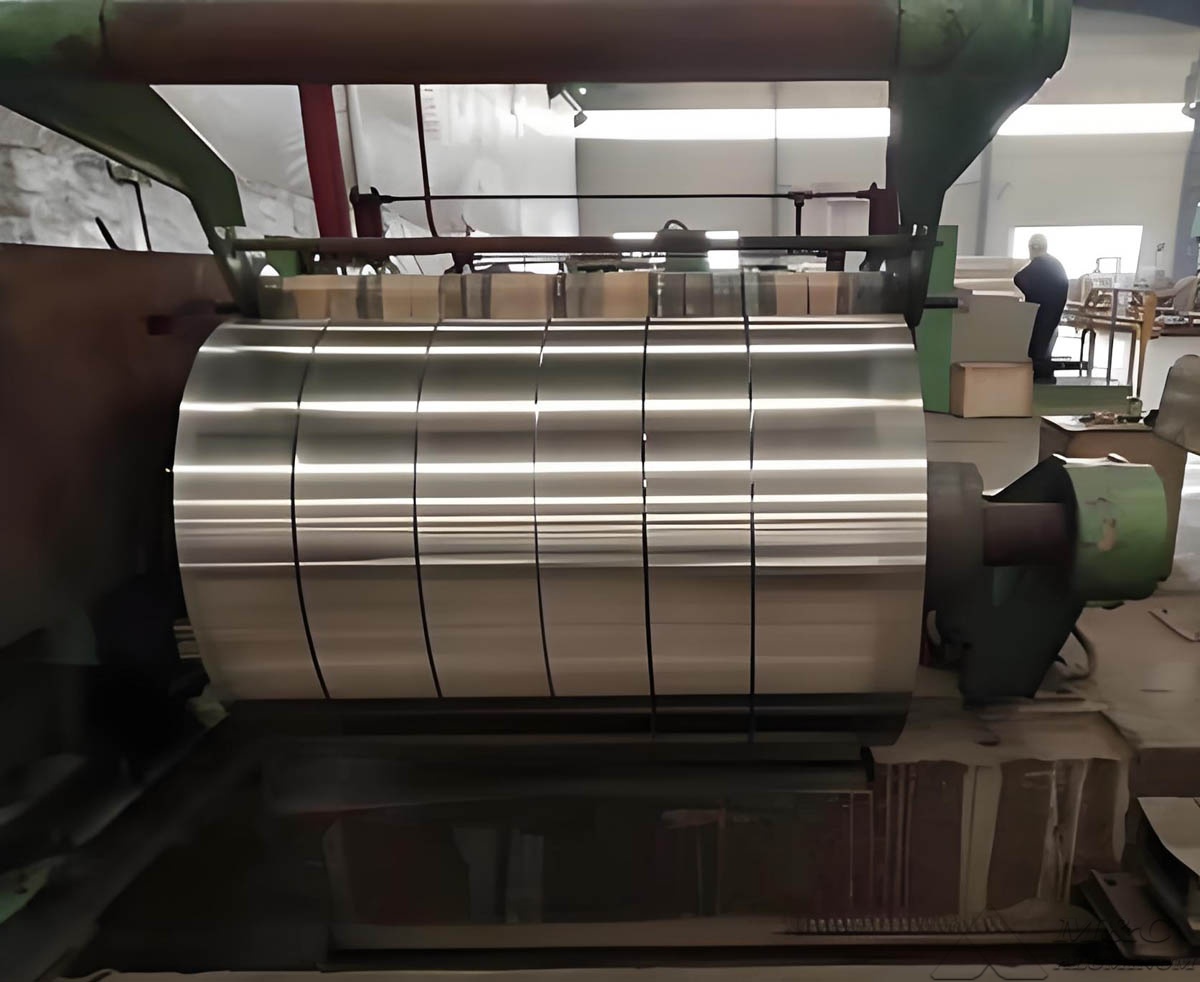
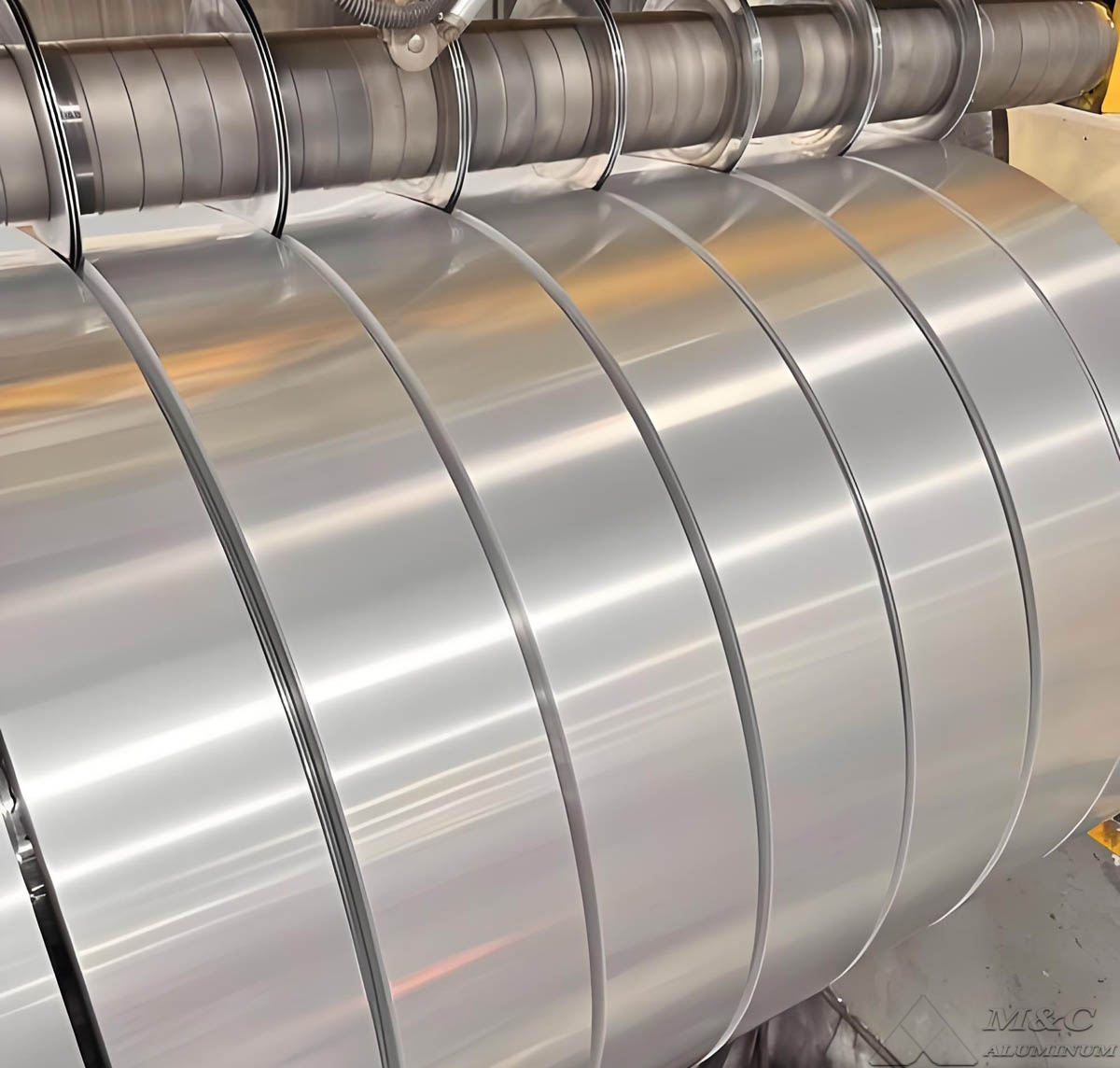
Slitting is one of the most important steps for transformer aluminum strip. The slit width must be accurate, and the edge must be suitable for insulation contact. We use controlled slitting equipment and inspect strip width, burr, camber, and coil condition.
Improper slitting can cause burrs, edge cracks, waves, or poor recoiling. These problems may not be acceptable for transformer manufacturers. Therefore, slitting quality control is a major part of our factory inspection system.
Inspection and Packing
Before shipment, transformer aluminum strip is inspected for dimensions, surface quality, coil appearance, and packaging condition. Depending on the order requirement, we can provide test data such as chemical composition, mechanical properties, conductivity, and dimensional inspection results.
Export packaging is designed to protect the coils from moisture, impact, and deformation. For long-distance sea transportation, moisture-proof film, desiccant, edge protection, and strong wooden packaging are commonly used.
Selection Considerations for Transformer Manufacturers
When selecting transformer aluminum strip, buyers should not evaluate the material only by alloy and price. The following factors are important for stable production and transformer performance:
Required conductivity and transformer loss target.
Strip thickness, width, and tolerance.
Temper and elongation suitable for winding tension.
Burr control and edge safety for insulation protection.
Surface cleanliness for paper wrapping, resin casting, or oil insulation.
Coil inner diameter, outer diameter, and weight suitable for equipment.
Packaging method suitable for storage and international transport.
A well-specified aluminum strip helps transformer manufacturers improve winding efficiency and reduce quality risks. As a factory, we recommend confirming drawings, technical standards, winding method, and packaging requirements before production.
Quality Control Points for Export Orders
For international engineering projects, transformer aluminum strip must be consistent from batch to batch. We focus on traceability, process records, and inspection before delivery. Each production stage is controlled to reduce variation and ensure the product can meet the customer's manufacturing conditions.
Key quality control points include alloy verification, rolling tolerance, annealing uniformity, conductivity testing, slitting edge inspection, coil tightness, surface cleanliness, and moisture-proof packaging. If the customer has specific standards, such as EN, ASTM, GB, or enterprise specifications, we can manufacture and inspect according to agreed requirements.
Conclusion
Transformer aluminum strip plays an important role in modern transformer manufacturing. It is used as an electrical conductor in distribution transformers, dry-type transformers, oil-immersed transformers, reactors, and other winding applications. Its importance comes from its direct effect on conductivity, heat generation, insulation safety, winding stability, and long-term reliability.
From a manufacturing perspective, high-quality transformer aluminum strip requires more than producing a coil with the correct width and thickness. It requires control of alloy purity, rolling accuracy, annealing condition, surface cleanliness, burr height, coil shape, and export packaging. By managing these factors in our factory process, we provide aluminum winding strip suitable for demanding electrical applications and consistent transformer production.
Contact Us